Maths
Maths Intent at Holy Family
We strongly believe that all children, no matter what their starting points, can become confident, competent mathematicians. The use of Inspire Maths Mastery is fundamental to ensuring children experience a range of concrete, pictoral and abstract learning to maximise their understanding of mathematics. It is essential that, through EYFS and KS1, children have a secure knowledge of number at the earliest opportunity and use all available time to make as much progress as possible in this area. Our Maths curriculum, through consistent high expectations and challenge, ensures the majority of children leave KS2 with sustained Mastery. This means children are fluent in basic concepts, can reason mathematically and are able to make links with their knowledge to solve problems in relation to National standards. It is our intent that children build on some of the school’s intents in Maths specifically, working independently and collaboratively, building on prior knowledge, show resilience and peer and self-reflect.
Certificate of appreciation for taking part in an EEF Maths Mastery project
The children selected three number cards, identify their positions on a number line by drawing jumps from zero or building a train and then ordered them from smallest to greatest.
Children compared the prices of items in pairs using counters/1p coins. They discuss with their partner which item had the greatest value and why.

In Year 4, we have been looking at efficient strategies for multiplication and division. We have spotted patterns and how numbers can be manipulated.
Year 1: Numbers to 20
In this lesson, the children were making a number line. The children made connections between the cardinal representations (quantity of cubes) and ordinal representations (positions on the number line).
The children, in pairs, described each pattern and discussed/agreed which shapes would come next in the pattern. The children then reported back as a class, giving reasons for their decisions.
Children created their own repeated patterns using 2D shapes and/or colours.
Year 5 - Autumn 1
Year 5 have covered reasoning with large numbers which included place value and rounding, integer addition and subtraction and read and interpreting line graphs and timetables.
Year 1: TT rockstar day
The year 1 children loved celebrating TT rockstar day. Here are a few pictures of the fun they had.
Children in year 4 enjoyed celebrating TT Rockstars day, during the PE lesson they learnt a Rock dance and shared examples of these with their peers. They also spent time on TT Rockstars battling one another and even Miss Dyson
FS1: TT Rockstars
The Nursery children have had a fantastic time taking part in our whole school TT Rockstars Day!
They loved dressing up as rockstars, strumming guitars, and most importantly—doing lots of fun maths activities. We’ve been busy matching amounts, singing number rhymes, and exploring all the exciting maths resources in our provision.
Reception TT Rockstars
Reception had a fantastic time celebrating our whole school TT Rockstars Day! The children loved dressing up as rockstars and had lots of fun making their very own number guitars. They linked their music lessons to TT Rockstars by using their bodies to make music, and they also explored a wide range of exciting maths activities and resources across our provision.
Year 3 have been exploring place value of 3 digit numbers. They have partitioned 3 number in different ways and used the correct mathematical vocabulary.
The children explored whether the number can be split into two equal groups by picking up two at a time and sharing them into the parts.
Children sorted the shapes into two sets in different ways, each time stating the parts and the whole. Record each relationship on a part-whole model.
Children ordered the numbers to 10 flash cards and practiced counting and identifying amounts. Then, the children played ‘Ten-Frame Flash’ in groups.
Using 2 sets of objects pictures, the children created towers. They used these towers to decide whether it is greater, less than or equal.
Maths Learning from 2024-2025
Year 1: Multiplication and Division
Children used equipment to create different rectangular arrays.
We read the story 'Where's Spot?'. The children talked about where Spot was on each page and then followed instructions to put Spot in different places in nursery.
Children worked together to solve the puzzle. They used bead strings or other manipulatives to support their calculations.
Year 1: Money
Children looked at the physical characteristics and properties of UK coins. They then grouped and sorted coins according to their physical properties.
Year 4: Decimals
Year 4 have explored fractions and decimal. They have compared and ordered numbers with one or two decimal places, and multiplying and dividing decimals by 10 and 100.
The children calculated how much money each pupil has left, representing each calculation with Dienes or a bead string on the part-whole model. They practised regrouping one ten for ten ones, describing this to a partner.
The children calculated the total cost of each child’s sweets by representing each amount on a part-whole model. They practised regrouping ten ones for one ten, describing this to a partner.
The nursery children have been learning about number 4. They have practised forming number 4, finding 4 objects, counting on and back to 4 and looking at the composition of 4.
WOW! What amazing skills the children in Reception have shown when doubling and halving. They doubled flowers and compared methods and found half of numbers to 10 and related to doubling.
During this lesson, children used a range of manipulatives to form and recognise the place value in different 3-digit numbers.
Year 1: Comparing Mass using Standard Units
The children compared the mass of each box to a kilogram, using a balance scale.
Children were asked to sort some 3D shapes according to how many vertices they have and whether the shapes have a curved or flat face. Children had to use overlapping circles and decide which shapes went in each part.
Year 2: Faces, shapes, lines and patterns
In this lesson, children completed a number of investigations. They focused on developing their oracy skills by explaining their reasoning.
Children in Reception have been getting better at counting in groups of two to find the total.
Year 6 - Decimals and Measure
Year 1 used the Cuisenaire rods. They worked in pairs to investigate double and half of a colour's length.
Children used their hands, feet, lolly stick or paper clips to measure classroom objects, attaching sticky notes to show their results. They compared the objects, saying which are longer/shorter (and by how much).
The nursery children have been learning about height and length. They enjoyed using the beanstalks to compare and order height.
Children have been getting better and finding totals, adding amounts and subtracting amounts.
Turtle is going to see Anansi for dinner. The children described the route that Turtle takes using the star words. Children challenge themselves by finding multiple routes for the turtle.
The nursery children have been practising subitising and counting. The children had to practise saying what they could see. They had to say very quickly how many puffs of smoke they could see coming out of the volcano. The children also practised their counting and matched the towers to the correct numeral.
Year 2: Money
In this lesson, children used money to respond to some questions. They then deepened their learning by giving reason and problem-solving.
The nursery children have been exploring number 3. They have looked at different ways they can show the number 3.
Children placed the concrete representations that they made in order. Children were given time to complete any towers for numbers 0 to 15 needed so that they can place all numbers 0 to 15 in order. children discussed the order, saying where they started ordering the towers and in which direction.
Children used the number lines and Cuisenaire ‘one’ and ‘two’ rods to identify numbers with a difference of 1 and 2.
Year 3: Calculating with multiplication and division
Here is a display of year 3‘s fantastic learning in our most recent maths unit. The children have enjoyed using different calculation methods to understand their learning.
To familiarise themselves with using a protractor, the children in year 5 explored measuring a variety of angles provided and then investigated angles they could find around the classroom. Some children commented about how many right angles were around the room and discussed why that was.
Year 6 - Fractions
In Maths, Year 6 learnt about fractions - ordering and comparing fractions, adding and subtracting fractions, multiplying fractions, dividing fractions and more..
Children in Reception created a concrete representation of counting equal groups and adding them together using cubes.
Children worked in pairs, with a bead string each. They identified the number on the bead string and found numbers greater and less than it.

Children investigated how many dinosaurs there would be in each area if 25 dinosaurs were placed in equal groups.
The children found heavy and light objects. They discovered that sometimes big objects can be light!

It was lovely to see the children in year 5 finish their current maths journey, learning about fractions and decimals. Take a look at their learning above!
Children chose a number between 20 and 50 and represented it in concrete, pictorial and abstract ways.
The children worked in pairs, using cubes, a bead string, a part-whole model and wipeable number line. Children picked an equation and chose which strategy to use to carry out the calculation and justify why they have chosen that strategy. They sorted the calculations according to strategy.

Children in Reception counters and the number track to solve how many people were on the bus.
Year 5- Fractions and Decimals
To develop an understand of tenths, hundredths and thousandths, the children in year 5 worked in groups to complete a sorting exercise where they had to match the visual representation of decimals using dienes with their number representation.

Children in Reception played a 'flapping fish game' to help them learn ordinal numbers.
The children listened and followed direction and turn songs.
The children investigate whole, half and quarters turns. They predicted the position and tested if they were correct.
Year 2: Time
Year 2 have been using the clocks to secure their understanding of telling the time. They have been focusing on telling the time in five minute intervals, well done Year 2.

Using clocks, the children looked at what happens to a clock’s hands as one hour passes. They add one hour or half an hour onto an o’clock or half past time.
We have been busy learning about number 1 this week. We have been counting to 1, making 1 on a five frame and finding 1 object.
Year 1 explored telling the time to o'clock and half past. They described where the hands need to be.
Reception children getting better at counting up to 9 objects.
Year 1: Time: O'clock
Year 1 explored telling the time to o'clock. They described where the hands need to be.
Children in Reception have been consolidating learning number bonds in their maths meeting.
Children in Reception used different resources to count and identify numbers to 7.
Year 1 explored one more and one less using numberlines in their maths meeting.
Year 1: Time: Months of the Year
The children ordered the months of the year with a partner.
Year 6 - Missing angles and coordinates and shape
Year 3: addition and subtraction
Here is are pieces of children’s learning from our most recent maths unit. The children have explored different calculation methods such as column and bar charts, to solve tricky 2 and 3 step word problems.
In maths the children have been comparing objects by their size and using the language of big, large, little and small. We even introduce medium too!
Practical Activity: Investigate the bus problem
Children explored the problem and looked at how many different solutions they can find. They used concrete manipulatives and pencils and paper to record their ideas. They then shared their ideas and findings to the rest of the class. They also used themselves and made a huge bus on the carpet to prove the solutions.
In this lesson, children used a range of manipulatives to create arrays, exploring repetition and making links to multiplication and division.
Practical Activity: Applying the ‘Make ten’ strategy
Children worked in pairs to decide whether or not to use the ‘make ten’ strategy for the callculations.
Stepping into Maths - Parent Session 2
This second parent’s maths session was all about matching Numicon shapes to numerals, combining, equivalence, pattern and generalising and using Numicon to add. All the children worked extremely hard and completed some really tuff challenges.
All parents that attended, were given a Numicon starter pack to use at home with their child along with some number cards. Throughout the afternoon, activities were demonstrated so parents could use these at home to support their child.
Year 1 completed an investigation about odd and even numbers. They looked at whether the number is fair or unfair and shared the number to check. They also recognised the pattern odd, even, odd, even.
Stepping into Maths in Reception - Parent Session 1
During the first session of Stepping into Maths in Reception, parents were introduced to Numicon and it was explained how it is a must-have resource in teaching the early year's maths curriculum and that they are perfect for tactile, multi-sensory, hands-on learning experiences. Parents were told that using Numicon regularly, empowers children to become familiar with the shapes, recognising them visually and linking them to the representative of number. Children completed different activities using Numicon and thoroughly enjoyed having their adult join them in their learning.
Year 2 Measures: Length
In this lesson, children completed a number of challenges and used a measuring tape to measure.
Year 1: Maths through Stories
Year 1 really enjoyed listening to the importance of stories in maths. They loved hearing one of the stories and were shocked to see someone from our school ask a question on the live.
Year 2: Maths through stories
Year 2 took part in a webinar with Kersti Worsley a famous author of 'Maths through stories'. Emme also asked a question and went live, 'Did you like writing stories when you were my age?'
Reception children have been recognising, describing and copying colour and size patterns. They have Created and described their own colour and size patterns and are counting one, two and three objects reliably.
Year 1: Numbers to 20: Comparing and Ordering
The children selected three number cards, identify their positions on a number line by drawing jumps from zero or building a train and then ordered them from smallest to greatest.
Year 3-Exploring calculation strategies
The children in year 3 have been working hard to develop their understanding and concepts of calculation strategies and applying them to their learning. Year 3 have also been looking closely at interpreting graphs, bar chars, pictograms and reading data. Here are some fantastic examples of our year 3 learning.
Year 6 - Multiplication and Division
Year 1: Numbers within 20: Numberlines
Making a number line:
Children are making connections between the cardinal representations (quantity of cubes) and ordinal representations (positions on the number line).
Year 1: Position and Direction
The children used their direction knowledge and vocabulary to navigate the BeeBot or a 'human robot' to find the shape treasure. The children also created an algorithm and predicted where the floor toy will finish.
Lots of mathematical exploration has been happening in FS2. Children have been sorting collections of objects in different ways, sorting shapes based on colour, sorting concrete objects to form sets, matching pairs and lots more!
Year 2: Bar models
In Year 2, children used cubes to represent bar models. They looked at a number of word problems and created bar models by drawing pictures within the frames. It was then interesting to hear children's reasoning as to the strategy they selected.
Children created their own repeated patterns using 2D shapes and/or colours.
Year 2: Cuisenaire investigation
Year 2 enjoyed using the cuisenaire rods for their end of unit consolidation lesson. They worked in pairs to solve a range of investigative problems, marvellous mathematicians.
FS1 - ROCK STARS


We had lots of fun counting and singing number rhymes on Thursday and of course a little bit of guitar playing too!
Year 1: TT Rockstar Day
Year 1 loved dressing up for TT Rockstar day! They also had fun dancing to rock and maths songs.
Year 6 - TT Rockstars Relaunch Day!
Year 2 thoroughly enjoyed the TT Rockstar day, we enjoyed using the ipads to access TT Rockstars and a whole day of maths learning and investigations....marvellous mathematicians Year 2!
Year 3: Times Table Rockstars
Year 3 enjoyed taking part in TT rockstar day. We have been focusing on our 3, 4 and 8 times tables. The children have enjoyed having a focus on Maths and building up their points on TT rockstars whilst competing against others and aiming to beat their high scores.

Children in Reception dressed as rock stars to celebrate Maths.
Year 1: 3D Shapes
Year 1 explored 3D shapes. They built the tallest tower using different shapes, describing the towers using correct mathematical vocabulary. They also sorted the shapes into two groups and justify how they are sorting each shape.
FS1 - Maths
The FS1 children have been sorting objects according to their colour, shape or size.


The children used both addition and subtraction to complete this missing number challenge. They needed to work out which number was missing to make the line add up to 10.

Year 2 have explored numbers within 100 and have now moved on to looking at adding and subtracting two 2-digit numbers. They have been focusing on recognising tens and ones in a number and then applying the most efficient strategy to complete the equation.
Year 4: Reasoning with large numbers
Year 4 have developed their understanding of the number system by investigating and manipulating 4 digit numbers. They have explored 10, 100 and 1,000 more and less than a given number. Additionally, they have also built on previous learning of rounding to the nearest 10 and 100, and developed new skills in rounding to the nearest 1,000. The children have also applied all of the taught skills to problem solving.
Year 6 - Integers and Decimals
‘Sweetie Jar Challenge’
Roll a die and counting on from four and see which jar of sweets fills up first. Use any of the three methods: concrete, number track or mental.

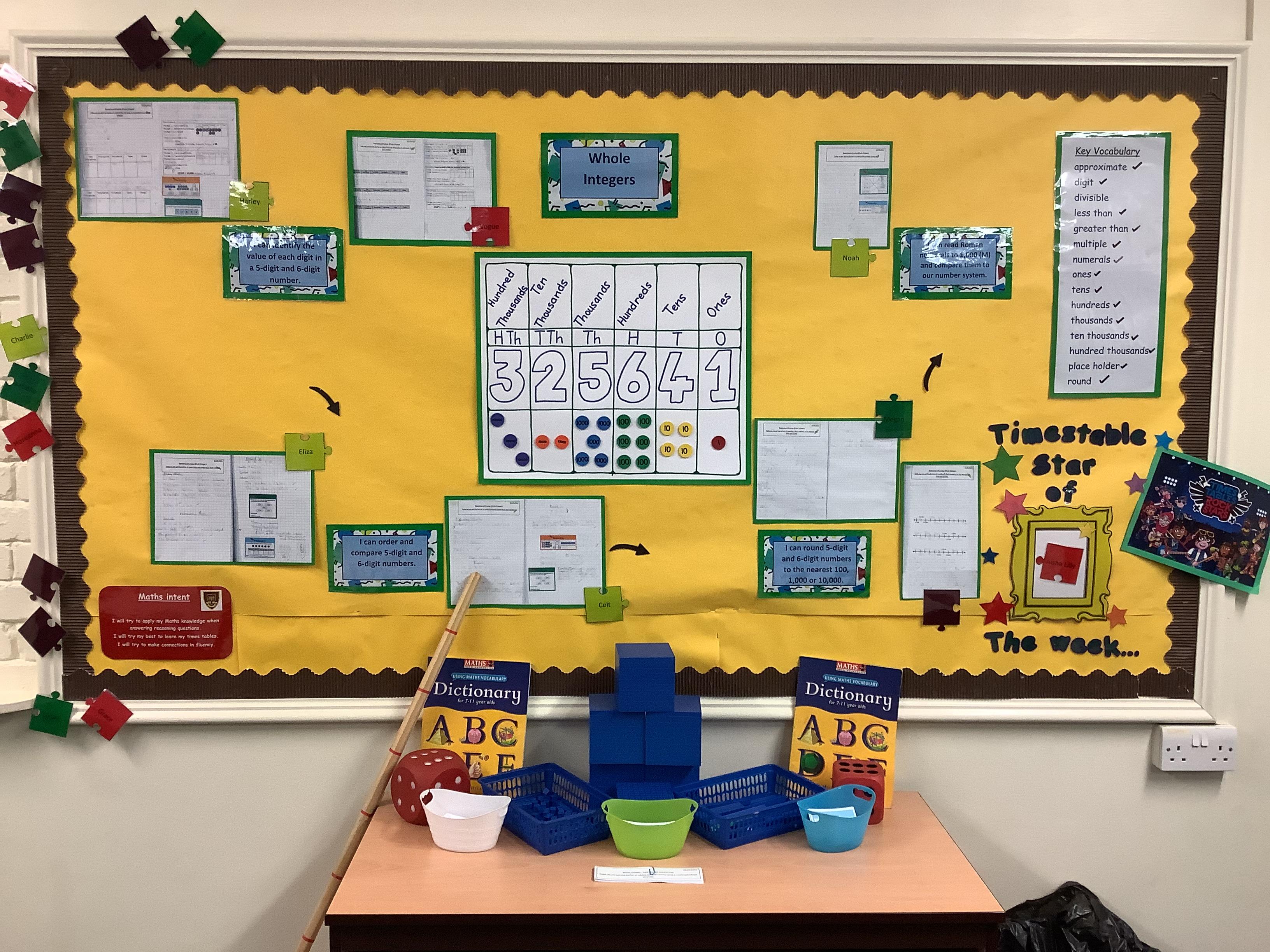
The children in Year 5 have now finished their first maths unit of the year, learning to reason with large whole numbers. From identifying, comparing and ordering 5 and 6-digit numbers, to rounding to the nearest, 1000, 10,000 and 100,000, the children enjoyed challenging themselves with reasoning questions and even singing songs to learn Roman numerals.
If the children would like to teach you the Roman numeral song and show you their learning, scan the QR code below.

Children explored whether a number could be split into two equal groups by picking up two at a time and sharing them into the parts.
Year 3: Number bonds to 20
In our topic, number sense and calculation strategies, the children have been using Cuisenaire rods to investigate all the number bonds to 10, and 20.
The children explored different formations in which their ten boats could sail and identifying the part-whole relationships within ten.
Year 1: Numbers to 10
Children sorted the shapes into two sets in different ways, each time stating the parts and the whole. Record each relationship on a part-whole model.
Year 1: Numbers to 10
Children ordered the numbers to 10 flash cards and practiced counting and identifying amounts. Then, the children played ‘Ten-Frame Flash’ in pairs.
Year 2: Numbers within 100
In this lesson, children explored numbers within 100. We used a range of manipulatives to make different numbers focusing on the place value of each digit.
Year 1: Numbers within 10
The children used 2 sets of objects pictures to create towers and used these towers to decide whether there are equal or not.
Year 1: Capacity and Volume
Measuring to the nearest litre, half a litre or quarter of a litre. Pupils take it in turns to measure either one quarter or one half litre and pour it into the large container. The pupil who makes the container overflow loses.

Children in Reception worked together to make shapes using shapes. They used problem solving skills, shared resources and used newly taught vocabulary to make different shapes, making sure they all matched.
Year 1: Multiplication and Division: Arrays
Children used their square tiles to create different rectangular arrays. compare sets of arrays, Children explained what’s the same and what’s different.
Applying a strategy to solve the puzzle:
Children worked together to solve the puzzle. They used bead strings or other manipulatives to support their calculations.
Year 2: Mass
In Year 2, children worked together to solve a range of investigations. They consolidated their learning by applying everything they have learnt in this unit and then worked collaboratively to solve investigations Miss Dyson and Miss Gibson set them.
Year 1: Money
Children looked at the physical characteristics and properties of UK coins. They then grouped and sorted coins according to their physical properties.
Year 4- Decimals
In Year 4, the children have studied decimals and solved problems using their knowledge of place value.

Year 4 have been studying fractions in maths. Take a look at their learning journey!

Children in Nursery have been learning all about shape. They really enjoyed using lego to print different shapes.

The children in year 5 learnt all about identifying, comparing and ordering fractions and how to read, write and order numbers up to 3 decimal place. Take a look at our learning...
Y3-Angles and shapes
Here is our display, and some of the children’s learning from our unit of shapes and angles. The children have enjoyed learning about 2D and 3D shapes, parallel and perpendicular lines, symmetry and developing understanding of angles.
Shop Subtraction Challenge:
The children calculated how much money each pupil has left, representing each calculation with Dienes or a bead string and put this on the part-whole model. They practised regrouping one ten for ten ones, describing this to a partner.
Sweet Shop Addition Challenge:
The children calculated the total cost of each child’s sweets by representing each amount on a part-whole model. They practised regrouping ten ones for one ten, describing this to a partner.
Y2: Capacity and volume
Year 2 enjoyed experimenting with different apparatus, predicting and measuring the different capacities and volumes of objects within the classroom.
Year 1: Length and Mass: Comparing to 1kg
The children compared the mass of each box to a kilogram, using a balance scales.

The children in year 5 enjoyed learning all about area and perimeter in rectilinear and non-rectilinear shapes. Take a look at their amazing learning journey!
Y3-Fractions
In year the children have learnt about fractions. They have enjoyed heightening and developing their knowledge of equal and unequal parts, unit and non-unit fractions, finding fractions of a given quantity, comparing and ordering, equivalent fractions and adding fractions.
Year 2- Numbers to 1000
Children in Year 2 were getting betterr at comparing numbers to 1000. They took turns to roll a dice and then create a 3-digit number. They then had to compare that number with the number their partner rolled.
Year 1: Length and Mass: Weighing objects in non standard units
Children chose a unit and wrote it at the top of the sheet (e.g. ‘marbles’).
They choose five objects. For each one, they predicted the mass, then weighed it using a balance scale and their chosen unit.
Year 1: Length and Mass: Comparing the masses of three objects
Children had a pair of balance scales and three items of ‘post’. They used their problem solving skills to work out and order the packages from lightest to heaviest.
Year 1 have used problem solving skills to explore doubling and halving.
Investigating halving lengths:
They worked in pairs to investigate which coloured rod is half the length of the brown rod. They take it in turns to choose two of the same colour of rod and place them together against the brown rod. Children then investigate other halves they can find within their set of Cuisenaire rods.
Investigating doubling lengths:
They worked in pairs to investigate which rod is double the length of the purple rod. They take it in turns to choose a bar to compare to the length of two purple rods. Children then investigate other doubles they can find.
Year 1: Length and Mass: Measuring using standard units
Exploring measuring using a metre stick.
Children worked in pairs to measure classroom objects using a metre stick with four equal subdivisions. They chose items which are shorter than one metre in length.
Year 6 - Percentages and Statistics
Year 6 - Decimals and Measure
Y3-Time
In year 3, the children have been learning about time. The children have built their conceptual understanding of time and used this to recognise, explain, estimate and order throughout this topic.
Year 1: Fractions: Turns and Directions
Turtle is going to see Anansi for dinner. The children described the route that Turtle takes using the star words. Children challenged themselves by finding multiple routes for the turtle.
Children picked a word problem and decided whether it was an addition or subtraction. They completed the problem using manipulatives.
Children worked in pairs, with a bead string each. They identified the number on the bead string and found numbers greater and less than it.
Year 1: Numbers to 50: Tens and Ones
Children chose a number between 20 and 50 and represented it in concrete, pictorial and abstract ways.
Year 1: Selecting Strategies for addtion within 20
The children worked in pairs, using cubes, a bead string, a part-whole model and wipeable number line etc. Children picked an equation and chose which strategy to use to carry out the calculation and justify why they have chosen that strategy. They sorted the calculations according to strategy.
Year 1: Make ten method
In this lesson, the children used bead strings to complete the ‘make ten’ strategy. We discussed the use of the tens frame and the bead string and decide which strategy they preferred.
Year 6 - Fractions
Year 6 represented fractions, found equivalent fractions and decimals, added and subtracted fractions, multiplied fractions and divided fractions
Year 2: Fractions
In this lesson, year 2 were getting better at identifying fractions of shapes with different numerators.
During the talk task they identified different fractions and then sorted them into a Venn diagram, fantastic!
Using clocks, the children looked at what happens to a clock’s hands as one hour passes. They add one hour or half an hour onto an o’clock or half past time.
Maths Numicon Maths Meeting - 2
This second maths session was all about matching Numicon shapes to numerals, combining, equivalence, pattern and generalising and using Numicon to add. All the children worked extremely hard and completed some really tuff challenges.
Year 1 - Time
In year 1, we are getting better at knowing and ordering the months of the year. The children ordered the months of the year with a partner.
Year 6 - Missing Angles and Length
In Missing Angles and Lengths, Year 6 learnt angle facts, angles in triangles and quadrilaterals, missing angles and lengths and recapped on measuring and drawing angles accurately
Y3-Learning journey
This term,Y3 have been working hard to use the column method to calculate addition and subtraction. Y3 have also enjoyed completing their length and perimeter unit, exploring all the ways to measure and calculate distance.
The children in Year 2 have started their new unit of learning: multiplication and division. They have explored arrays, developing vocabulary such as represent, value and commutativity.
Y3-Maths-Length and perimeter
Y3, have been looking at estimating using their finger, and then finding the actual measurement of flat objects using a ruler. The children were careful to line their ruler up to 0, to gain the correct and exact measurement to the nearest Cm and Mm.
Year 6 - Calculation problems
Year 6 used their knowledge of place value and the four operations from previous units to solve calculation problems
Making a number line:
Children are making connections between the cardinal representations (quantity of cubes) and ordinal representations (positions on the number line).
Year 1 Unit 3: Shape and Patterns
Year 1 - Position and Direction
In Maths, we linked our position and direction learning to our Autumn 1 unit of Computing. We discussed the keyword algorithm and recalled what it meant. We then created multistep algorithms to move Ted the Teddy around the grid. We used lots of key vocabulary to describe the movements.
In Maths, Year 6 have completed their second topic; Multiplication and Division. Children learned place value including up to 3 decimal places, multiplying and dividing by 10, 100 and 1000, prime numbers, factors and common factors, and formal methods for multiplication and division...
maths
Maths in Nursery
In Nursery, we are learning about colours. We are recognising them, naming them and sorting them into groups. We have also been finding two things that match exactly. We have lots of Autumn leaves in our outdoor area so we collected some and compared their size. We sorted them into big leaves and little leaves then made a wreath by pushing little leaves onto the wire and another one by pushing big leaves onto a bigger wire.
Y3
Y3 have been creating different numbers using number cards. They have been using multiplication, addition, division, and subtraction skills to create 2 and 3 digit target numbers. They have been using each card only once. Y3 have been explaining and justifying their choices, using the language of place value.
Year 5- Line Graphs and Timetables
The children have started their topic by exploring the story of a graph, working collaboratively to share and explain their learning.
Look at our Addition Sweet Challenge in year 1.
Year 1 started their maths journey looking at numbers to 10. First, we looked at composing and counting numbers. Then, we looked at part wholes and the number bonds to create each number. Finally, we also compared and ordered numbers. Look at all the fun we have had.
Y3
Y3- Our first units of learning have been number sense, and calculation strategies. Year 3 have been using known facts to work out calculations, and number bonds to 20. Y3 then moved on to Place value, where they have been applying their skills to create target numbers. Our final unit of learning this term has been Graphs. The children have enjoyed Reading, comparing, and creating scaled bar charts and interpreting data to form pictograms.
Y3 finding number bonds to 10 & 20

Year 2 have enjoyed their first unit within our math's learning journey. They have been reading, writing, represented, partitioned, compared and ordered numbers within 100. They then moved on to exploring patterns including odds and evens and tens and ones.
Year 5 Maths- Whole Integers
Year 5 have been exploring whole integers including place value, the worth of a digit, rounding and Roman numerals.
Take a look at our amazing work...